
Last Sunday afternoon I arrived at Rowe Sanctuary along the south side of the Platte River in central Nebraska at 4:15 to prepare for experiencing the spectacular annual spring migration of sandhill cranes from an overnight blind. I checked in with a volunteer inside the Iain Nicolson Audubon Center then returned to my truck to await transport via UTV to the blind with all of my photography and camping gear. As a first-timer spending the night with the cranes, I was very excited by this opportunity after having to re-schedule my original date of March 18 due to the blizzard that hit the eastern half of Nebraska.
At 5:30 I was settled into the cozy 6x8x6 carpeted blind equipped with nothing but a bucket potty then prepped my camera gear. Rules stipulate that once inside I could not leave until a volunteer retrieved me the next day. That happens only after the bulk of the cranes leave the river by mid-morning to spend the day in nearby fields and wet meadows.
 It had been a brisk cloudy 40-degree day with a stiff northwest wind blowing directly into the blind, so multiple layers of warm clothes were required from head to toe. I could hear cranes all around as I patiently waited for them to come to the river. I could see small groups flying around as daylight waned, then around 8:00 it happened.
Tremendous numbers of cranes appeared overhead and began to parachute down onto sand bars. The sound of shrill calls was incredible and practically deafening as thousands and thousands of birds arrived.
Unfortunately, the cranes’ late arrival in such low light conditions didn’t present me with the best image making conditions, but I kept shooting anyway using a high ISO setting. The river water seen directly behind the blind was 30 feet away. As the birds filled in, some drank out of that water and that entire area was covered with cranes.
Loud crane chatter lasted well into total darkness but things were quieter during the cold overnight hours as many of the birds slept. Heaters are not allowed in the blinds, so staying warm was definitely a challenge, particularly as the temperature dropped to 30 degrees. Thankfully, the wind died down quite a bit so it wasn’t nearly as drafty in the blind after about midnight.
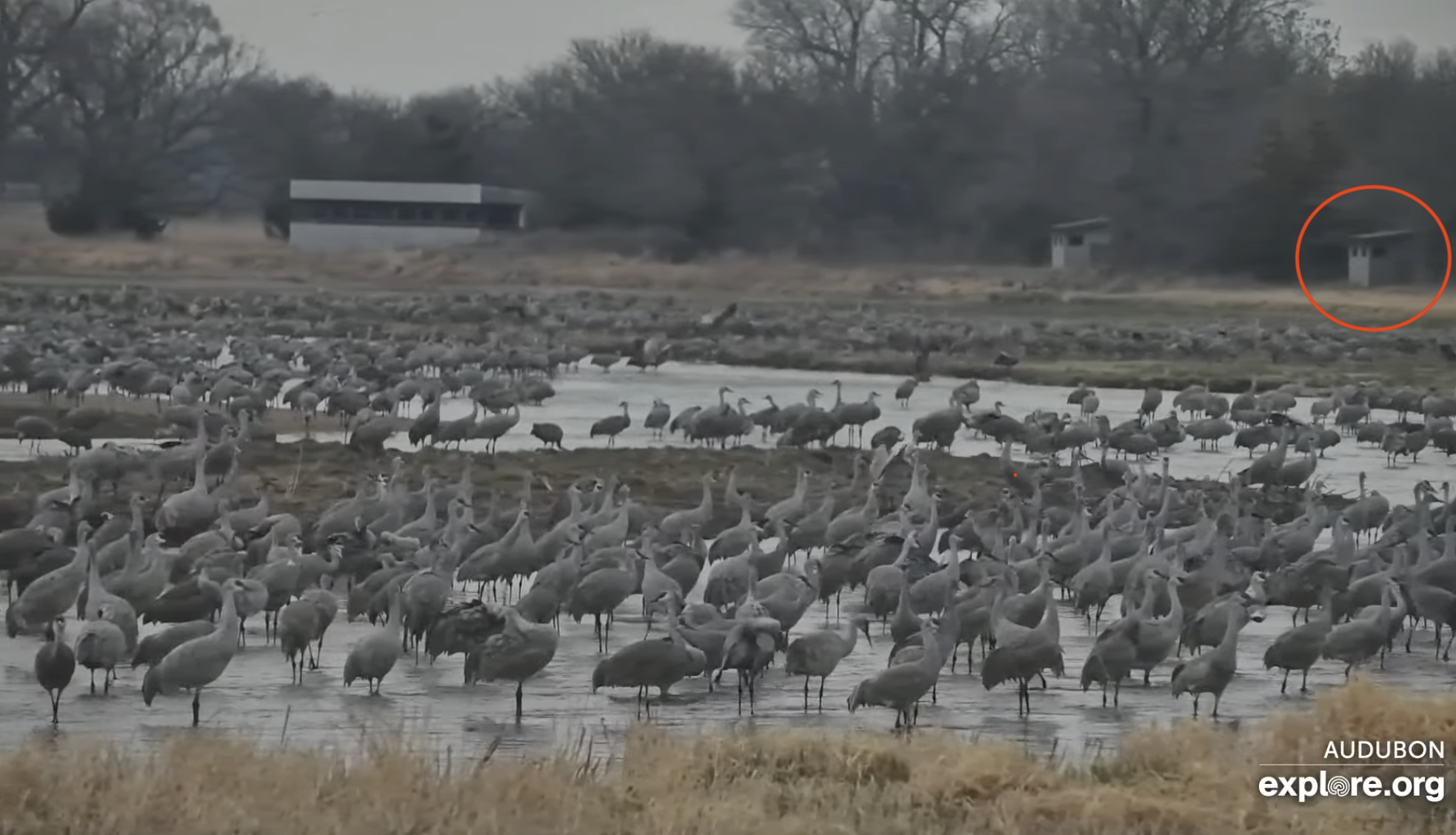 It was a restless night of sleep as I tried to stay warm and comfortable inside my sleeping bag with several layers of clothing still on, including a coat, gloves, and heavy socks with hand warmers inside, and a stocking cap on my head. I know I slept some but not very much. The screen capture on the right shows the blind I was in and a fraction of the cranes that were present Sunday night.
I crawled out of my sleeping bag at 6:30 the next morning then packed it up along with my ground pad and some other things as I waited for good morning light to get to work with my camera. The cranes were already stirring and the noise level increasing as they began to mill about on the sandbars. I observed them preening, drinking, pecking at the sand, and showing off for each other.
Eventually the cranes worked at stretching their wings as they prepared to evacuate the river. Small groups began leaving and birds from other roosts filled the sky. Then came two massive lift offs of birds as the majority of them took to the air and headed for places where they would spend their day.
By the time a volunteer arrived I was completely packed up, so I was out of the blind quickly and back at my truck in just a few minutes. My hot water didn’t stay hot enough overnight, so I was very excited to head inside the visitors center to fill my coffee mug and peel off some layers of clothing. I had a chance to chat for a while with two others who were in the blinds on either side of me roughly 100 feet away before I departed.
This was an experience I’ll never forget, and one that will get repeated next year.
